
Cost of Retiring in Thailand in 2026: The Real Monthly Budget After the $500 Myth
The myth of retiring in Thailand on $500 a month is one of those beautiful internet stories that refuses to die. It sounds simple: cheap food, warm weather, no winter, lower rent, the sea, fruit, street markets, smiling daily life — and suddenly retirement begins to look almost free.
There is one small truth inside this myth. Thailand can be cheaper than the United States, the United Kingdom, Australia, Canada, or Northern Europe. A retiree can spend less on food, local transport, household services, basic rent, simple cafes, laundry, haircuts, small repairs, and everyday help. In the right place, with the right lifestyle, the difference can be real.
But “cheaper” is not the same as “safe.” And “possible” is not the same as “reasonable.”
The $500 story usually counts only the pleasant visible part of Thailand. It counts rice, noodles, fruit, and a cheap room. It does not count health insurance after 60, private hospitals, visa extensions, a Thai bank account, air conditioning, taxes, exchange-rate losses, flights home, dentistry, a medical emergency, household replacement, and the fact that old age is not a backpacking trip.
So the useful question is not whether someone can survive in Thailand on very little money. Some people can survive almost anywhere on very little money. The useful question is different:
How much does it cost to retire in Thailand with a normal level of legal, medical, and financial safety?
That answer is less romantic. But it is the answer a retiree actually needs.
The $500 Myth Breaks as Soon as You Add Real Life
At an approximate exchange rate of 33 Thai baht to one U.S. dollar, $500 is about 16,500 baht. The exchange rate changes, so a serious budget should always be checked against the official Bank of Thailand data. But the rough number is enough to understand the problem.
16,500 baht can cover a very simple life if nothing goes wrong. A basic room. Local food. A phone plan. Very careful electricity use. Some local transport. Almost no medical reserve. Almost no document mistakes. Almost no travel. Almost no protection.
That is not a retirement budget. That is a fragile monthly survival number.
The first hard check is the visa logic. For the common retirement extension route, official Thai government information refers to financial requirements such as 800,000 baht in a Thai bank account, monthly income of 65,000 baht, or a combination method. The official Thailand government portal describes this on its page for staying in Thailand in the case of retirement.
65,000 baht is roughly $1,970 at 33 baht to the dollar. This does not mean every retiree spends exactly 65,000 baht every month. But it does show the scale of the system. Thailand may be affordable. It is not built around the idea that a foreign retiree can live safely and legally on $500.
| Monthly budget | Approximate baht amount | What it really means |
|---|---|---|
| $500 | About 16,500 THB | Survival level. Not a protected retirement budget. |
| $1,500 | About 49,500 THB | Possible for one careful person in a cheaper location, but with weak margin. |
| $2,500 | About 82,500 THB | A more realistic working budget for one retiree outside the most expensive lifestyle. |
| $3,500 | About 115,500 THB | Comfortable for one person in many places; controlled, not luxurious, for many couples. |
Thailand Is Still Cheaper — But Only If You Count the Whole Life
The attractive part of Thailand is not fake. A bowl of noodles can still be cheap. A local market can make a Western supermarket feel absurd. A taxi ride, haircut, laundry service, or simple repair can remind a retiree why so many people first fall in love with the country.
But a retirement budget is not built from the cheapest lunch. It is built from the whole month, the whole year, and the bad month that eventually comes.
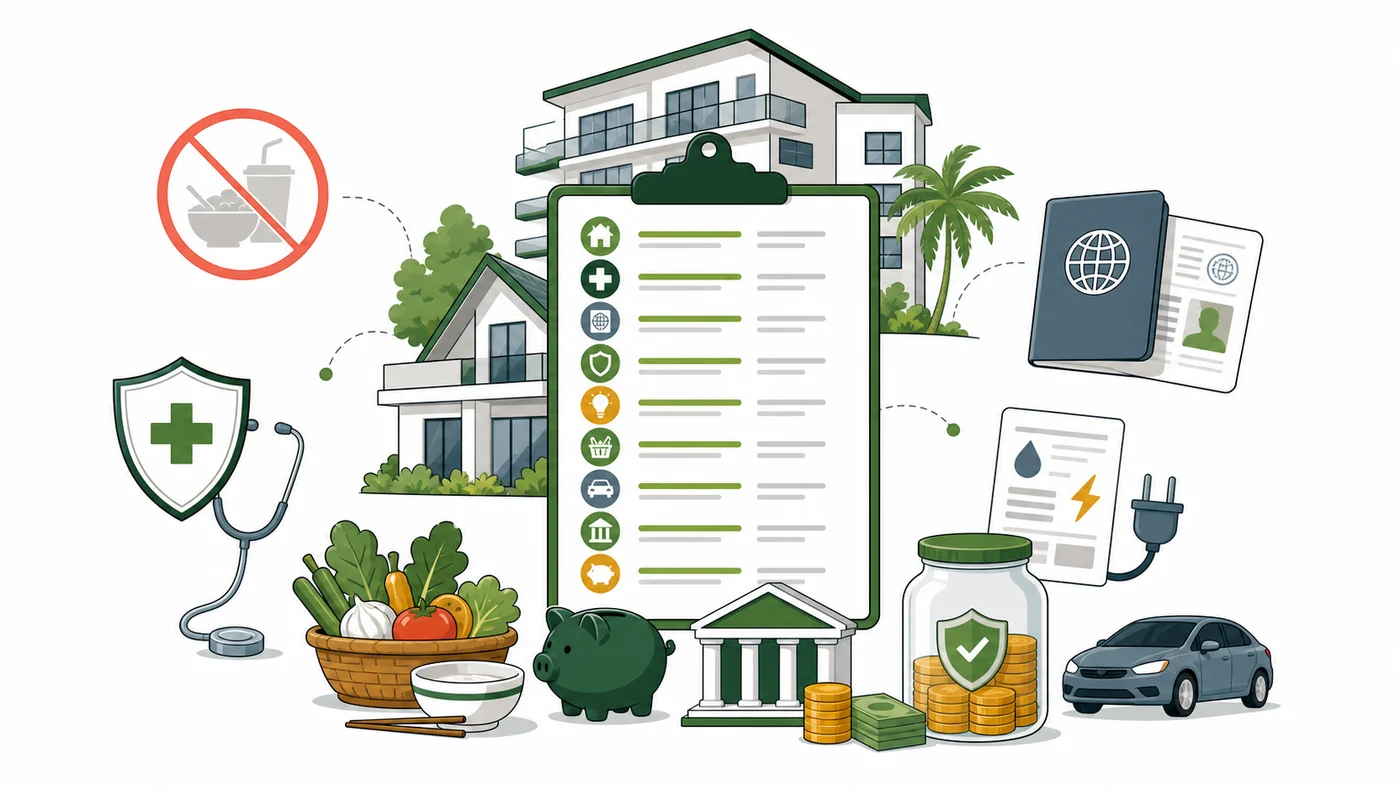
A real Thailand retirement budget must include housing, utilities, food, transport, healthcare, insurance, visas, banking, currency loss, taxes, documents, household replacement, flights home, and emergency reserve. If the budget has no line for medical risk, it is not a retirement budget. If it has no line for visa and address paperwork, it is not a Thailand budget. If it has no reserve, it is not a plan. It is hope.
This is the difference between a tourist calculation and a retirement calculation. A tourist can leave when the situation becomes uncomfortable. A retiree may have a lease, belongings, doctors, documents, a Thai bank account, a visa timeline, medicine, a spouse, pets, and a body that no longer likes sudden disruption.
Housing: Cheap Rent Is Not Always Good Retirement Housing
Housing is usually the first reason Thailand looks financially attractive. Compared with New York, London, Sydney, Melbourne, Toronto, Amsterdam, Stockholm, or other expensive Western cities, Thai rent can look generous. For a retiree leaving a high-rent market, the difference can feel almost unreal.
But housing for retirement is not the same as housing for a short stay. The question is not only “How cheap is the room?” The question is whether an older person can live there safely, comfortably, and repeatedly, month after month, year after year.
A cheap apartment on the fourth floor without an elevator may be tolerable at 60 and become a trap at 75. A beautiful sea-view unit may be emotionally perfect and practically weak if the hospital is too far away. A low rent in a remote area may stop being a saving if every doctor visit, supermarket trip, document appointment, or airport run requires expensive transport.
Thailand has very different retirement geographies. Chiang Mai may offer strong value, good cafes, services, and a slower daily rhythm, but it has no sea and has a serious air pollution season. Pattaya and Jomtien have housing supply, hospitals, sea access, and expat infrastructure, but the quality of life changes sharply by neighborhood. Hua Hin feels calmer and more retirement-oriented, but good housing near services can cost more than expected. Bangkok gives the best hospitals, transport, and airports, but rent rises quickly near BTS and good districts. Phuket and Samui can look like retirement paradise and behave like expensive tourist economies.
| Location | Financial meaning | Main caution |
|---|---|---|
| Chiang Mai | Often strong value for one retiree who does not need the sea. | Air pollution season can be serious, especially for breathing and heart issues. |
| Pattaya / Jomtien | Many rental options, hospitals, sea access, and foreigner infrastructure. | Area quality and daily atmosphere vary sharply. |
| Hua Hin / Cha-am | Calmer, more retirement-style, with sea and access to Bangkok. | Good housing near infrastructure can be less cheap than the myth suggests. |
| Bangkok | Best medical depth, transport, services, and international access. | Rent, air quality, noise, and city pace can be difficult. |
| Phuket / Samui | Sea, international lifestyle, and strong tourism services. | Seasonality, transport, rent, and private healthcare can make costs jump. |
The cheapest city is not automatically the best retirement city. Sometimes paying more for access to hospitals, transport, elevators, stable housing, and a quieter daily life is not waste. It is risk management.
Utilities: Air Conditioning Is Part of the Health Budget
Old Thailand budgets often treat electricity as a small afterthought. This is a mistake. Thailand is hot, humid, and for many retirees physically demanding. Air conditioning is not a luxury line for everyone. For people with asthma, heart conditions, blood pressure problems, poor sleep, or heat sensitivity, it becomes part of the health budget.
Electricity depends on consumption, building quality, insulation, window direction, the number of air conditioners, the season, and whether the bill is paid directly to a provider or through a landlord. Official tariff information and the Ft component are published by the Provincial Electricity Authority.
A retiree who is home most of the day uses the apartment differently from a tourist. The air conditioner may run during afternoon heat. Fans may run all day. The refrigerator works harder. A hot month can turn a neat budget into a less neat one.
Saving on electricity is possible. But after a certain age, living in heat to protect an unrealistic budget is not financial discipline. It is a warning sign that the budget is too low.
Food: Thailand Is Cheap If You Truly Live Locally
Food is where Thailand still gives real relief. Local markets, simple Thai dishes, fruit, rice, noodles, soups, grilled chicken, vegetables, and basic cafes can keep daily spending lower than in Western countries. A retiree who genuinely enjoys local food and does not need Western groceries every day can live well for less.
But imported life is not cheap. Cheese, wine, good bread, Western breakfasts, special diet products, gluten-free food, organic products, imported meat, familiar supplements, and international brands change the calculation quickly. Restaurants in tourist areas also change it.
Thailand can feed a person cheaply. It does not necessarily feed every version of a Western lifestyle cheaply.
This matters because food is emotional. A person may tell themselves they will eat local food every day, then discover after six months that they miss familiar breakfasts, familiar bread, familiar cheese, familiar coffee, or food that fits a medical diet. That is not weakness. That is life. The budget should include the person who will actually live there, not the person who appears in a spreadsheet.
Transport: The Cheap Option Is Not Always the Safe Option
Transport in Thailand can be inexpensive, but the correct answer depends heavily on where the retiree lives. Bangkok has BTS, MRT, taxis, and hospital access if the neighborhood is chosen carefully. Official BTS fares can be checked through the BTS Skytrain fare page.
Outside Bangkok, the situation becomes more practical and more dangerous. In Chiang Mai, Pattaya, Hua Hin, Phuket, or Samui, the cheapest solution is often a motorbike. But for a retiree, a motorbike is not just a cheap transport tool. It is accident risk, hospitalization risk, insurance risk, liability risk, license risk, and police risk.
This is where “cheap” can become fake cheap. A motorbike may cost little each month. One accident can cost far more than years of taxis. For many retirees, paying more rent to live within walking distance of services, hospitals, supermarkets, and cafes may be financially rational.
In Thailand, location and transport should be calculated together. A cheap apartment that forces daily transport may not be cheap. A more expensive apartment near services may quietly save money, stress, and risk.
Healthcare Is Where the Cheap-Country Story Becomes Serious
Healthcare is the budget line that changes everything.
Routine care in Thailand can be attractive. Private hospitals in major areas can be fast, organized, English-speaking, and easier to navigate than crowded systems at home. Check-up packages may look reasonable. Dental care may be cheaper than in the United States. A normal consultation may not be frightening.
But retirement healthcare is not measured by the normal consultation. It is measured by what happens when the problem is not small.
Stroke, heart attack, oncology, ICU, surgery, hip fracture, rehabilitation, dementia, long-term nursing, repeated imaging, chronic medication, and medical evacuation are the real questions. A country can be affordable for ordinary life and financially dangerous during a serious medical event.
For Americans, the warning is direct: Medicare usually does not cover healthcare outside the United States, except in limited situations. For British retirees, GOV.UK states in its Living in Thailand guidance that the UK and Thailand do not have a reciprocal healthcare agreement and that medical insurance is needed. For Australians, Smartraveller warns that overseas medical treatment may require payment upfront: Medical assistance overseas.
This is the sentence that should sit at the center of every Thailand retirement budget: the visa gives the right to stay, but it does not pay the hospital.
A retiree can make Thailand look cheap by removing insurance and medical reserve from the budget. But that is exactly how the budget becomes dangerous.
Insurance After 60 Is Not One Simple Price
When people ask how much health insurance costs in Thailand, they often expect one clean number. But after 60, insurance is not just a monthly or annual price. It is a contract full of limits.
The real questions are less comfortable. Are pre-existing conditions covered? Is cancer covered properly? What happens after 65, 70, or 75? Is renewal guaranteed? Is medical evacuation included? Are the preferred hospitals in the network? Will the hospital bill directly, or demand payment first? Are there waiting periods? What is excluded in small print?
Some Thai long-stay routes also have formal insurance logic. The Ministry of Foreign Affairs describes the Non-Immigrant O-A route on its Non-Immigrant Visa O-A page. But even when insurance is not the central requirement for a specific retirement route, it remains part of the real cost of aging in Thailand.
This is why a $1,500 budget may be possible on paper and fragile in life. If it has no serious medical layer, it depends on luck.
Visa Costs Are Not Only Government Fees
Visa fees themselves may look small. The system around them is not small.
For retirement life, the real cost includes bank documents, income proof, a Thai bank account, address registration, TM30, copies, photos, transport, agent help if needed, re-entry permits, residence certificates, translations, timing mistakes, and the possibility that a rule or bank practice changes when the person is already inside the system.
This is why Thailand retirement planning should be connected to long-term stay planning from the beginning. A person does not only rent an apartment. They enter an administrative rhythm.
The first year is often the most annoying because everything is new: the bank account, the visa route, the address record, the extension, 90-day reporting, medical setup, local phone, and document habits. Later, the system may become routine. But routine still costs money and attention.
A very low budget has no room for administrative friction. And Thailand, like many countries, has administrative friction.
Taxes and Currency: The Quiet Pressure on Fixed Income
Many retirees think of Thailand in rent and food prices, but the deeper issue is fixed income. A pension may be paid in dollars, pounds, euros, or Australian dollars. Spending happens in baht. The retiree lives between currencies.
If the baht strengthens or the home currency weakens, Thailand becomes more expensive without asking permission. If bank fees and exchange-rate spreads take a few percent each month, the loss may look small once and become meaningful over a year.
The World Bank’s Remittance Prices Worldwide project explains that transfer costs include not only visible fees but also exchange-rate margins: World Bank methodology. For retirees who transfer money regularly, this is not theoretical. A 2-4% loss on monthly transfers can quietly remove hundreds or more than a thousand dollars a year.
Taxes also must be checked before the move, not after it. The Thai Revenue Department explains that a person staying in Thailand for 180 days or more in a calendar year may become a Thai tax resident, with rules for Thai-source income and certain foreign-source income brought into Thailand: Personal Income Tax. U.S. citizens and resident aliens generally remain subject to U.S. worldwide income reporting rules, as explained by the IRS. UK retirees must also pay attention to pension rules abroad, including State Pension uprating rules explained by GOV.UK. Australians should check tax residency with the Australian Taxation Office.
Taxes may not destroy the Thailand plan. Currency may not destroy it either. But both destroy the fantasy that the only calculation is rent and street food.
What $1,500 Really Buys
$1,500 a month, or roughly 49,500 baht, is the lower edge where a careful single retiree may be able to live. But it is not a relaxed number. It usually requires a cheaper city, modest housing, mostly local food, careful electricity use, few flights, no expensive lifestyle, and no large medical problem.
For someone who already knows Thailand, understands local systems, has savings outside the monthly budget, and is comfortable living locally, this may work. For a first-time retiree arriving with romantic expectations, it is fragile.
The danger is not that $1,500 is impossible. The danger is that people may treat it as safe when it is only possible.
At this level, one medical surprise, one expensive visa mistake, one urgent flight, one bad rental choice, or one insurance problem can change the year. This is not a budget for chaos. It is a budget for discipline.
What $2,500 Really Buys
$2,500 a month, roughly 82,500 baht, is a much more realistic number for one retiree. It gives space for better housing, more stable utilities, some private healthcare planning, transport, documents, and a small annual reserve.
It does not create luxury. It creates breathing room. And in retirement, breathing room is not decorative. It is what prevents every problem from becoming a crisis.
At this level, Thailand can work well if the retiree avoids the most expensive tourist areas and does not import an entire Western lifestyle. Chiang Mai, Pattaya / Jomtien, Hua Hin, and parts of Bangkok can become realistic. Phuket and Samui may still be possible, but the budget becomes more dependent on rent, transport, season, and medical strategy.
$2,500 is the point where Thailand begins to look less like survival and more like a serious retirement plan for one person. But it still requires calculation. It is not a blank check.
What $3,500 Really Buys
$3,500 a month, roughly 115,500 baht, is comfortable for one person in many parts of Thailand. It allows better location choices, more reliable housing, stronger medical planning, regular air conditioning, taxis, occasional travel, and less stress around documents and emergencies.
For a couple, this may still be a controlled budget rather than an abundant one. The couple shares rent, but not medical aging. Insurance and healthcare can easily become the line that decides whether $3,500 feels generous or merely adequate.
This is why the right answer is not “Thailand costs $1,500” or “Thailand costs $3,500.” The right answer is: Thailand costs very different amounts depending on whether the budget includes aging.
What a Real Monthly Budget Looks Like
There is no one number for every retiree. A healthy single person in Chiang Mai is not the same as a couple in Phuket. A retiree with a paid-off home abroad and strong savings is not the same as a retiree living only on a monthly pension. A person who eats local food and walks everywhere is not the same as a person who needs imported groceries, taxis, premium hospitals, and frequent flights home.
Still, a practical budget can be shown in ranges. The point is not to make a perfect accounting sheet. The point is to show the difference between survival, ordinary stability, and real safety.
| Budget level | Approximate monthly amount | What it usually buys | Weak point |
|---|---|---|---|
| Very tight | 45,000-55,000 THB | Simple housing, local food, careful utilities, limited comfort. | Little room for insurance, illness, flights, or mistakes. |
| Realistic modest | 55,000-80,000 THB | Better stability in cheaper cities, some medical reserve, less daily anxiety. | Still vulnerable to serious healthcare and expensive locations. |
| Normal retirement life | 80,000-120,000 THB | Normal rent, air conditioning, mixed food, transport, documents, medical planning. | Insurance, exchange rate, and serious hospital risk must still be watched. |
| Comfortable | 120,000+ THB | More choice of area, housing, private healthcare, travel, and reserve. | Can still be stretched by Phuket, premium hospitals, or a couple’s insurance. |
For a couple, the calculation does not simply double. Housing and internet may be shared. But medical risk, insurance, visas, flights, medicine, and personal expenses are attached to each person. A couple may live cheaper per person, but it also carries two bodies into the same budget.
Where Thailand Still Wins
Thailand still has real financial strengths. It can offer a warmer climate, lower daily service costs, strong private healthcare in major areas, easier help with household tasks, a broad rental market, good food, and a softer rhythm of life than many expensive Western cities.
For a retiree leaving a high-rent city, Thailand can dramatically improve daily comfort. If the person chooses the location intelligently, lives partly local, avoids the most expensive expat habits, and plans healthcare properly, the country can still be a very strong retirement destination.
This is not an anti-Thailand argument. It is an anti-fantasy argument.
Thailand is not expensive because noodles became expensive. Thailand becomes expensive when the retiree needs legal status, private medicine, insurance, good housing, safe transport, and resilience.
Where Thailand Becomes Expensive
Thailand becomes expensive when the lifestyle is built around tourist geography and Western expectations. Sea view, imported food, premium hospitals, private transport, frequent taxis, high season, islands, international insurance, regular flights home, and help with every document all add up.
The country can feel cheap in an ordinary month and expensive in a bad month. That is the most important sentence in the whole budget conversation.
An ordinary month is rent, food, cafes, electricity, and maybe a doctor visit. A bad month is a hospital admission, dental surgery, a rejected online report, a visa timing mistake, a sudden flight home, a falling currency, or a need to move. Retirement planning must include both.
This is why the cheapest version of Thailand is not necessarily the best version of Thailand. The better version may cost more every month and save the retiree from a much more expensive crisis later.
The Three-Layer Budget
The most honest way to calculate Thailand is not to make one beautiful monthly number. It is to make three budgets.
| Layer | What it counts | Why it matters |
|---|---|---|
| Normal month | Rent, food, utilities, phone, transport, daily life. | This shows whether everyday life works. |
| Real year | Insurance, visa extensions, flights, check-ups, repairs, documents. | This shows the average truth, not one good month. |
| Bad scenario | Hospital, surgery, evacuation, currency fall, urgent move, emergency flight. | This shows whether the retirement plan is safe or just lucky. |
If the budget survives only the first layer, it is not enough. If it survives the first two layers but collapses on healthcare, it is still weak. If it survives the bad scenario, then Thailand may be not only affordable, but genuinely workable.
The Practical Conclusion
Retiring in Thailand can still be financially attractive. That part is true. A retiree can get warmth, services, food, daily convenience, and sometimes much better quality of life for less than in an expensive Western city.
But the $500 myth is not a retirement plan. It is a fantasy built from the cheapest visible parts of life and silence around the expensive invisible parts.
$1,500 may work for one careful person in a cheaper location, but it is tight and vulnerable. $2,500 is a much more realistic base for one retiree who wants ordinary stability. $3,500 gives more comfort and choice, but still does not remove medical, insurance, currency, and visa risk.
For a couple, for Phuket, for Bangkok premium areas, for heavy private healthcare, for international insurance, and for regular flights, the real number can be higher.
The right conclusion is not “do not retire in Thailand.” The right conclusion is: do not retire in Thailand on a slogan.
Count the full life. Count the normal month. Count the real year. Count the bad month. Count the body you will have at 70 and 80, not only the appetite you have today.
The cheapest version of Thailand may be easy to imagine. The safe version of Thailand must be calculated.
Official and Useful Sources
For exchange-rate checks, use the Bank of Thailand. For the retirement extension financial logic, use the official Thailand.go.th page for staying in Thailand in the case of retirement. For electricity tariff information, check the Provincial Electricity Authority. For Bangkok train fares, check BTS Skytrain.
For healthcare risk, Americans should read Medicare.gov on travel outside the U.S.. British retirees should check GOV.UK Living in Thailand. Australians should check Smartraveller medical assistance overseas.
For tax and currency reality, use the Thai Revenue Department, the IRS rules for U.S. citizens abroad, GOV.UK State Pension abroad, the Australian Taxation Office, and the World Bank’s Remittance Prices Worldwide.