
Thailand Retirement Visa in 2026: How to Apply for Non-O and a One-Year Retirement Extension for the First Time
A Thailand retirement visa no longer looks like a simple scheme: arrive, open a bank account, deposit 800,000 baht, and get one year. Formally, the basic requirements are still recognizable: age 50+, money in a Thai bank account or confirmed income, no work, annual extension. But the practical reality has changed.
The main problem in 2025-2026 is often not immigration itself. The main problem often begins earlier: the Thai bank account.
For a standard retirement extension, a Thai bank account is usually needed. But opening a bank account in Thailand as a foreigner on a tourist status has become noticeably harder. Banks have tightened checks because of fraud, mule accounts, and accounts used to move money from scam networks. This means the old logic — come as a tourist, calmly open an account, deposit 800,000 baht and go to immigration — may not work now.
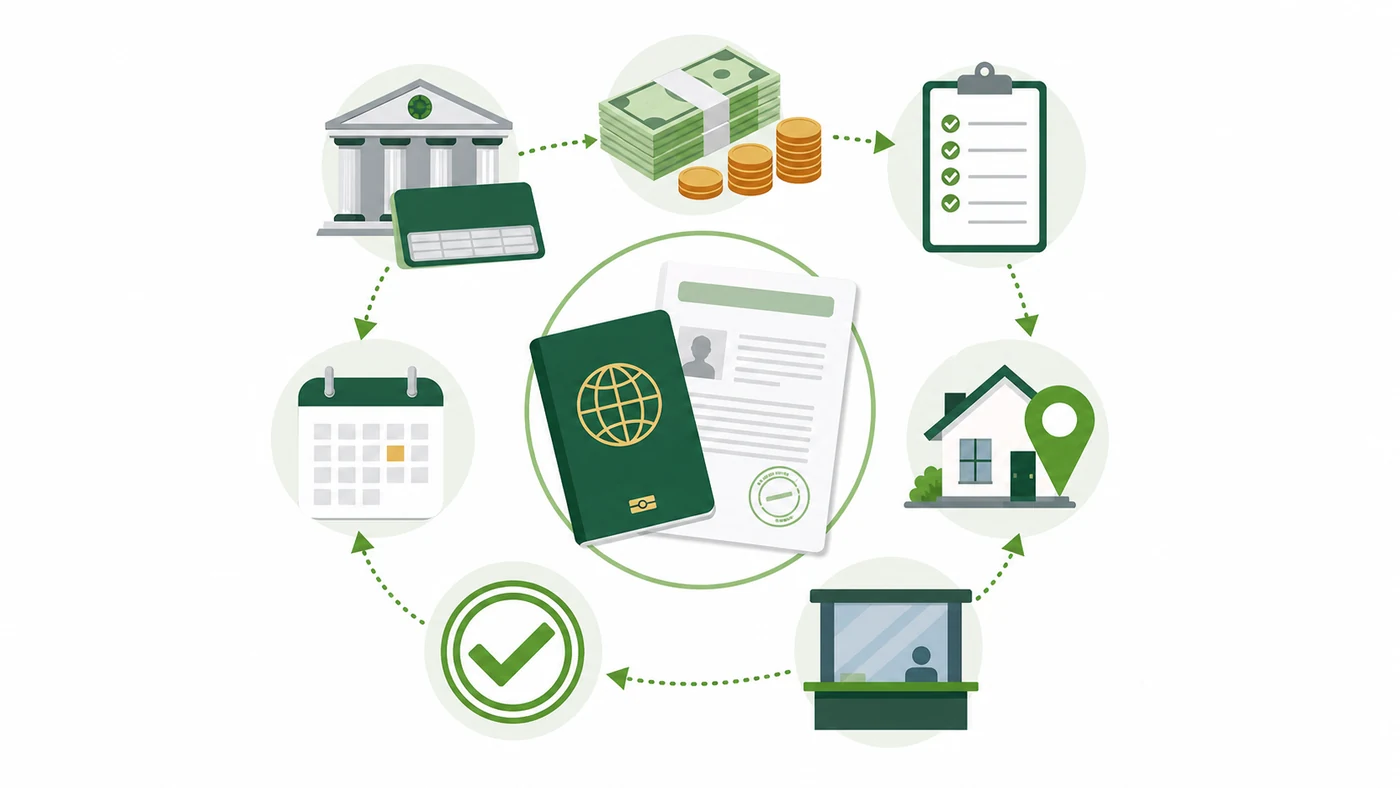
This does not mean the retirement path is closed. It means it has to be planned as a sequence: correct entry, address registration, bank account, money, timing, documents, first 90-day Non-O status, then a one-year extension based on retirement.
The practical conclusion is simple: in 2026, the Thailand retirement route is still real. But it is less tolerant of chaos, late timing, weak documents, and “maybe it will work somehow.”
What People Usually Call a “Thailand Retirement Visa”
In everyday speech, “retirement visa” can mean several different things. This is where confusion begins.
| Type | What it means | Why it matters |
|---|---|---|
| Non-Immigrant O based on retirement | Usually a 90-day non-immigrant visa or status used as the first step. | This is often the practical bridge to the one-year retirement extension. |
| One-year extension based on retirement | Permission to stay in Thailand for one year on retirement grounds. | This is what many people informally call the “one-year retirement visa.” |
| Non-Immigrant O-A Long Stay | A separate long-stay visa usually obtained outside Thailand through an embassy or consulate. | It has additional requirements, including medical insurance. |
| Non-Immigrant O-X | A long-term visa for citizens of limited countries with heavier financial requirements. | It is not the usual practical path for most first-time retirement applicants. |
This article is about the most practical route for many people: first getting Non-O status and then applying for a one-year extension based on retirement.
Basic Requirements
For the standard retirement route in Thailand, the basic requirements are:
- age 50 or older;
- no ban on entering Thailand;
- Non-Immigrant status;
- financial proof;
- address in Thailand and current residence notification;
- personal application;
- correct timing;
- no work in Thailand.
Work is not allowed on a retirement basis. This is not “remote work is fine if nobody sees it.” It is a retirement basis, not a work basis. If a person needs legal work status, the retirement route is the wrong tool.
A retirement visa gives the right to stay. It does not give the right to work.
Financial Requirements
The classic financial options are:
- 800,000 baht in a Thai bank account in the applicant’s name.
- 65,000 baht monthly income.
- A combination of income and bank balance that totals at least 800,000 baht per year.
For the first one-year retirement extension, the money in the Thai bank account usually must be seasoned before the application. In practice, the 800,000 baht route requires careful timing, not a one-day bank balance.
After the retirement extension is approved, the money regime also matters. The official Thailand.go.th page for retirement extension explains that after approval the 800,000 baht must remain in the account for 3 months, and after that the balance must not fall below 400,000 baht.
Important money logic
800,000 baht is not money to “show for one day.” The money must be in the right account, under the right name, for the right period, and then kept according to the post-approval rules.
Why the Old Scheme Became a Problem
Before, many people used a simple sequence:
- Come to Thailand on a tourist visa or visa exemption.
- Open a Thai bank account.
- Deposit 800,000 baht.
- Apply for change of status to Non-O.
- After 90 days, apply for the one-year retirement extension.
Now the weak point is the second step: opening a bank account.
Thai banks have become much more careful. The reason is not only that banks “do not like foreigners.” The reason is the fight against fraud, mule accounts, money laundering, and accounts used by scam networks.
The Bank of Thailand announced measures in 2025 to manage mule accounts more strictly. Banks are expected to identify suspicious accounts, refuse new accounts for high-risk persons, and exchange information more actively.
KASIKORNBANK also states on its official account-opening page that accounts are not opened for holders of tourist visas and visas intended for travel, including visa exemption and DTV.
So the circle is real:
- for retirement, you need a financial base in Thailand;
- for the financial base, you need a Thai bank account;
- the bank may not open an account without long-term status;
- long-term status often requires a bank account.
This is not an absolute wall. But it is no longer a simple household operation.
The Better Strategy in 2026
The calmer strategy now is not to start with tourist entry if the goal is already known in advance.
There are two practical routes.
Route 1
Get a Non-O retirement visa outside Thailand first, then enter Thailand, open a bank account, transfer money, and apply for the one-year retirement extension.
Route 2
Enter Thailand as a tourist or under visa exemption, then apply inside Thailand to change status to Non-O. This route officially exists, but the bank account issue can make it difficult.
Route 1: Non-O First, Then One-Year Retirement Extension
This is the most logical route if the person already knows they are going to Thailand for long-term retirement living.
The sequence is:
- Apply for Non-Immigrant O based on retirement outside Thailand through Thai e-Visa or an embassy / consulate.
- Enter Thailand with Non-O status.
- Make TM30 address registration at the place of residence.
- Open a Thai bank account as a Non-Immigrant status holder, not as a tourist.
- Transfer 800,000 baht from abroad.
- Keep the money in the account for the required period.
- Before the 90-day period ends, apply for the one-year extension based on retirement.
The advantage is clear: the bank sees a person with Non-Immigrant status, not a short-stay tourist.
The disadvantage is timing. If the Non-O entry gives 90 days and the money must be seasoned before the one-year extension, the bank account has to be opened quickly. Not after a month. Not when the person “settles in.” Practically immediately.
Timing is the whole system here. If the bank account is opened late, the money cannot season on time. If the money cannot season on time, the extension becomes a problem.
Route 2: Tourist Entry or Visa Exemption, Then Change Status Inside Thailand
This route officially exists. But in 2026 it is less comfortable because of the bank issue.
Thailand.go.th describes the application for change of visa for retirement purposes for people aged 50 or older. The applicant must have more than 15 days of permitted stay remaining. If the applicant is on overstay, the application cannot be submitted.
The forms are:
- TM86 — if the person entered with a Tourist Visa or Transit Visa and wants to change the type of visa.
- TM87 — if the person entered without a visa, for example under visa exemption, and wants to obtain Non-Immigrant status inside Thailand.
The problem is that this procedure already requires financial proof. If the person uses the 800,000 baht route, a Thai bank account is needed. But a bank account may not be opened for a tourist-status foreigner.
Therefore Route 2 often becomes a search for a bank solution. Sometimes it works through a particular bank, a particular branch, a residence certificate, housing documents, a letter, or a stronger explanation. Sometimes it does not.
The Bank Account Is a Separate Stage
In 2026, the Thai bank account is not a small technical detail. It is a separate stage.
To open an account, a foreigner may need:
- passport;
- valid visa or permission to stay;
- Non-Immigrant status, if the bank requires it;
- address confirmation;
- TM30;
- residence certificate from immigration;
- rental contract or condominium documents;
- Thai phone number;
- sometimes a letter from an embassy, overseas bank, employer, school, or another institution trusted by the bank.
Requirements differ not only between banks, but also between branches of the same bank. One branch may refuse. Another may accept. One employee may say “impossible.” Another may ask for an additional document.
But building a plan on “maybe we will be lucky” is a bad plan. If the goal is retirement, it is better to come to the bank as a stronger applicant: with Non-O status, address, TM30, rental contract or property documents, Thai phone number, and a clear reason for opening the account.
Why “Done for You Without Money” Is Dangerous
Old discussions often mention the option: “If there is no money, an agent will do the visa under the table.” In 2026, this must be treated much more sharply.
There are legal helpers who assist with appointments, copies, translations, correct forms, and normal account-opening procedures. That is one thing.
And there are gray schemes where someone creates bank documents, temporarily puts other people’s money, prepares fake confirmations, or submits documents in a way the applicant does not really understand. That is something else.
Because of the fight against mule accounts and financial crime, suspicious banking schemes are more dangerous now.
The visa is in your passport. The responsibility for the documents is yours. “The agent did it, I did not know” is not a strong protection.
Before Arrival: What to Prepare
Before arriving in Thailand, the first decision is the route.
If the person already knows that retirement stay is the goal, the documents should be prepared before the trip, not after arrival in confusion.
Before-arrival checklist
- Passport with enough validity.
- Photos 4×6 cm.
- Proof of age 50+.
- Financial documents.
- Pension or income documents, if using the income route.
- Marriage certificate, if a spouse is involved.
- Translation and legalization of marriage documents, if needed.
- Planned address in Thailand.
- Understanding of where and how the bank account will be opened.
- Enough time before the current entry status expires.
- Money for official fees and practical expenses.
- Separate reserve for healthcare and insurance.
The address should be exact: condominium name, building, floor, room number, district, province, postal code, phone number. The same address may be needed for TM30, bank, immigration, 90-day reporting, residence certificate, document delivery, and normal life.
After Arrival: Address Registration
After entry, the address has to be put in order.
For long-term stay, TM30 is important. It is the notification that a foreigner is staying at a specific address. It is usually the duty of the owner, hotel, landlord, condo juristic office, or another responsible host. But if TM30 is missing, the foreigner often receives the practical problem.
For the retirement route, TM30 matters because the official change-of-visa information refers to residential notification under Section 38.
The official TM30 system is here: TM30 Online System.
Practically, before applying for Non-O or a one-year extension, the applicant should have a current address and proof of residence notification.
First Stage: 90-Day Non-O
If the person entered Thailand with Non-O retirement already, this stage was done outside Thailand through an embassy, consulate, or e-Visa route.
If the person is already inside Thailand as a tourist or under visa exemption, they apply for change of visa or application for visa inside Thailand.
The usual document logic includes:
- TM86 or TM87;
- passport;
- copies of passport pages;
- latest entry stamp;
- current permission to stay;
- photo 4×6 cm;
- fee of 2,000 baht;
- financial documents;
- address documents;
- TM30;
- rental contract or property documents;
- map or direction sketch to the residence, if the office requires it;
- signed copies of documents;
- personal appearance.
The application should be submitted when more than 15 days of permitted stay remain. If there is too little time, the documents may not be accepted. If the person is already on overstay, the official information says the application cannot be submitted.
After approval, the applicant receives Non-Immigrant O status, usually for 90 days.
Second Stage: One-Year Retirement Extension
After receiving Non-O, the next step is the one-year extension based on retirement.
This usually uses form TM7, the application for extension of temporary stay.
Typical extension document set
- Passport.
- Copies of passport pages.
- Copy of Non-O visa or stamp.
- Copy of latest entry stamp.
- TM30.
- TM7 form.
- Photo.
- Bank book.
- Bank letter.
- Bank statement or account movement.
- Proof that money has been in the account for the required period.
- Address documents.
- Rental contract or property documents.
- Map or direction sketch to the residence.
- Fee of 1,900 baht.
After the one-year extension is granted, the applicant must still follow the rules:
- do 90-day reporting;
- keep TM30 / address record current;
- obtain re-entry permit before leaving Thailand, if the extension must be preserved;
- follow the bank balance rules;
- not work;
- prepare for the next annual extension in advance.
Single Entry, Multiple Entry, and Re-Entry Permit
This is a separate trap.
A one-year extension gives permission to stay in Thailand, but it does not automatically protect that permission if the person leaves Thailand.
If the person wants to leave Thailand and return without losing the extension, a re-entry permit is needed.
- Single re-entry — for one trip out and back.
- Multiple re-entry — for multiple trips.
If a person leaves Thailand without a re-entry permit, the permission to stay may be cancelled. This is a very unpleasant mistake.
A re-entry permit can usually be obtained at immigration or at the airport before departure. But leaving it until the last moment is not a good habit.
If a Married Couple Applies
There are several scenarios for a married couple.
Option 1: Both spouses are over 50 and each applies independently
This is the most independent option.
Each applicant submits their own document set. Each applicant proves their own financial qualification. Usually this means:
- each person has their own bank account;
- each person has their own 800,000 baht, if using the bank deposit route;
- or each person proves their own income;
- or each person uses the combination method.
The advantage is independence. The disadvantage is the financial burden.
A joint account may create problems. Immigration usually wants the money to be in the applicant’s name. With a joint account, it may be unclear which part of the money belongs to which applicant.
Option 2: One spouse is the main retirement applicant, the other is dependent / family member
This route may be possible in some cases, but it must be checked with the specific immigration office and the specific visa situation.
The Ministry of Foreign Affairs notes in the O-A context that if an accompanying spouse is not eligible for O-A, the spouse may be considered under Category O with a marriage certificate.
Immigration Bureau also has a public handbook for extension as a family member of an alien permitted temporary stay.
Practically, the dependent route may require:
- marriage certificate;
- translation;
- legalization;
- passports of both spouses;
- documents of the main applicant;
- valid Non-Immigrant status of the main applicant;
- address documents;
- TM30;
- photos;
- forms;
- proof that the spouse is legally a spouse, not just a partner.
The weakness of the dependent route is that the second spouse’s status depends on the first spouse’s status. If the main applicant loses the basis, fails to extend, or violates the rules, the dependent spouse also becomes vulnerable.
Option 3: One spouse uses retirement, the other uses another visa basis
Sometimes this is calmer. For example, if the second spouse is not yet 50 or has another real basis for stay. But then the basis must be real, not “something will be found later.”
If Using the 65,000 Baht Income Route
On paper, the income route exists. But in 2026 it may be more complicated than it sounds.
For change of visa, Thailand.go.th refers to a certificate from an embassy or consulate showing pension of not less than 65,000 baht per month, with evidence of source of income.
The problem is that not every embassy issues such certificates. Some countries stopped issuing income affidavits for Thai immigration. Then immigration may require other proof: regular international transfers, bank statements, pension confirmation, money movement.
For first-time retirement processing “from zero,” the income route can be less predictable than the bank deposit route. It may work, but it should be checked in advance with the local immigration office and based on the documents available from the applicant’s country.
Practical recommendation: if possible, the 800,000 baht bank route is often easier for an officer to understand than a complicated explanation of foreign income. But the bank route depends on opening the Thai bank account.
Non-O or O-A: Which One to Choose
For many people, ordinary Non-O retirement plus annual extension inside Thailand is more flexible than O-A.
Why:
- O-A is obtained through an embassy or consulate;
- O-A has medical requirements;
- O-A requires financial proof and additional documents;
- O-A has medical insurance requirements;
- ordinary Non-O retirement may be simpler in practice, but requires correct bank and immigration timing.
The official MFA page for Non-Immigrant O-A explains the O-A route and its requirements.
Ordinary Non-O retirement often looks more flexible, but the bank account and timing stages have to be handled correctly.
Medical Insurance
For Non-O-A, medical insurance is an important requirement. The Ministry of Foreign Affairs lists insurance requirements for O-A.
For standard Non-O retirement / extension based on retirement inside Thailand, insurance is not usually the same central requirement as for O-A.
But this does not mean insurance is not needed in real life. For a person over 50 in Thailand, absence of insurance is not courage. It is a financial risk.
If a person plans to grow older in Thailand, the medical part should be calculated before the visa, not after it. The visa gives the right to live. It does not pay the hospital.
What Changed Compared With Old Instructions
Old instructions were useful for their time, but several points must now be treated carefully.
Income affidavits are not universal
Before, many people used embassy income affidavits. Now this depends on the country. Some embassies issue them, some do not.
The bank became the bottleneck
Before, opening a bank account was often a normal practical action. Now it can be the main obstacle.
Tourist entry is less convenient
Change of status inside Thailand still exists officially. But if the bank does not open an account for a tourist, the route can stop before immigration.
Agent schemes are riskier
Because of attention to mule accounts and financial fraud, gray banking solutions are more dangerous.
Address documents also became more important in practice: TM30, rental contract, residence certificate, map to residence, exact address. These are not decorative papers. They are part of the practical file.
Step-by-Step: How to Do It the First Time
Step 1: Choose the route
If the person is not yet in Thailand, it is better to consider obtaining Non-O retirement outside Thailand first.
If the person is already in Thailand on a tourist status, they should immediately check:
- how many days remain;
- whether TM86 or TM87 can be submitted;
- whether a Thai bank account is already open;
- whether opening a bank account is realistic;
- whether the income route is possible;
- whether the local immigration office will accept the documents.
Step 2: Check remaining stay
For change of status inside Thailand, more than 15 days of valid stay should remain. It is better to have more than the minimum. Coming at the last moment is a bad strategy.
Step 3: Make TM30
The address must be registered. Without this, documents may not be accepted.
Step 4: Solve the bank issue
If using the 800,000 baht route:
- open the account;
- transfer the money from abroad;
- keep proof of foreign transfer;
- update the bank book;
- obtain a bank letter according to the local office rules;
- copy all relevant bank book pages.
For change of visa, Thailand.go.th states that the bank documents should be in the applicant’s name and dated / updated on the same date as the application.
Step 5: Apply for 90-day Non-O
Submit TM86 or TM87, passport, photo, financial documents, address documents, TM30, fee, and other documents required by the local office.
Step 6: Receive Non-O and control the timeline
Receiving Non-O is not the finish line. It is the intermediate stage. The one-year extension still has to be prepared.
Step 7: Apply for one-year retirement extension
Submit TM7, financial documents, address documents, passport, photo, and the 1,900 baht fee.
Step 8: After the one-year extension
After approval, the person must:
- follow the bank balance rules;
- make 90-day reports;
- get re-entry permit before leaving Thailand;
- keep documents;
- not work;
- prepare for the next extension in advance.
General Document List
For first-time processing, the document package may include:
- passport;
- passport copies;
- copy of visa or entry stamp;
- copy of latest entry;
- TDAC / arrival data, if required;
- TM30;
- TM86 or TM87 for change of status;
- TM7 for one-year extension;
- photos 4×6 cm;
- bank book;
- bank letter;
- bank statement;
- proof of foreign transfer;
- rental contract or property documents;
- chanote and blue book, if owning property;
- map to residence;
- exact address;
- telephone number;
- marriage certificate, if spouse is involved;
- translation and legalization of marriage document, if required;
- spouse’s document copies, if relevant;
- cash for fees;
- additional acknowledgement forms required by the office.
And yes: many copies are still needed. That has not changed.
Costs
The main official fees:
- change of visa / application for Non-O inside Thailand: 2,000 baht;
- one-year extension of stay: 1,900 baht;
- re-entry permit: separate fee, if leaving Thailand is needed.
Additional expenses may include:
- photos;
- copies;
- transport;
- bank letters;
- translations;
- legalization;
- residence certificate, if needed for the bank;
- helper services, if used;
- travel to another city or country, if the embassy route is chosen.
Main Mistakes
- Coming on tourist status and assuming the bank will definitely open an account.
- Waiting until the last 15 days.
- Not making TM30.
- Keeping money in a joint account.
- Not proving foreign transfer.
- Withdrawing money below the allowed level after extension.
- Leaving Thailand without re-entry permit.
- Thinking that 90-day reporting extends the visa.
- Using an agent without understanding what documents are submitted.
- Not legalizing marriage documents for the spouse route.
- Relying on old instructions without checking current office requirements.
- Listening to “everyone does it this way” instead of official requirements.
The Practical Conclusion
The retirement route in Thailand in 2026 remains real. But it has become less tolerant of chaos.
Before, many things could be done along the way: arrive, ask around, open an account, bring copies later, fix something at the counter. Now the weak point is the bank. If the bank account cannot be opened, the whole route may stop before immigration.
Therefore, the better approach is:
- if the goal is clear in advance, start with Non-O outside Thailand;
- do not rely on tourist status as an easy base;
- open the bank account quickly after arrival with the correct status;
- transfer money officially;
- keep address and TM30 in order;
- do not use gray financial schemes;
- plan spouses separately: independent retirement or dependent route;
- count all deadlines in advance.
A retirement visa is not “impossibly difficult.” But in 2026 it is no longer a light everyday procedure. It is a document project: status, bank, money, address, timing, copies, extensions.
And if it is handled as a project, not as hope for luck, it remains workable.
Official and Useful Sources
| Topic | Source |
|---|---|
| Change of visa for retirement purposes | Thailand.go.th: Application for change of type of visa |
| Retirement extension | Thailand.go.th: Application to stay in Thailand in the case of retirement |
| Non-Immigrant O-A | Ministry of Foreign Affairs: Non-Immigrant Visa O-A |
| Bank account documents for foreigners | Thailand.go.th: Bank account documents |
| KBank account rules | KASIKORNBANK: Open Bank Account |
| Anti-mule account measures | Bank of Thailand: Mule account measures |
| TM30 address notification | Immigration Bureau: TM30 |
| 90-day reporting | Immigration Bureau: TM47 |
| Family member extension | Immigration Bureau: Family member handbook |